









Choosing between HMPE rope vs wire rope is one of the most common decisions operators face in marine and offshore work. The wrong choice can mean extra weight on deck, higher maintenance, slower handling, or even reduced payload capacity. The right choice improves safety, lowers lifetime cost and makes daily operations smoother.
This guide gives a clear, practical comparison focused on real marine and offshore duties — mooring, deepwater lifting, towing and winch service — so you can select with confidence.
Table of Contents
- Key Takeaways
- What Exactly Is HMPE Rope?
- What Is Steel Wire Rope?
- HMPE Rope vs Wire Rope: Direct Comparison
- When HMPE Rope Is Usually the Better Choice
- When Steel Wire Rope Remains Preferable
- Can You Replace Wire Rope with HMPE on Existing Equipment?
- Practical Selection Checklist for Marine & Offshore Projects
- Making the Right Choice for Your Operation
Key Takeaways
- HMPE rope provides a very high strength-to-weight ratio, making it attractive for applications where line weight is a major concern.
- Wire rope remains the practical default on many existing cranes and winches because of proven heat tolerance, abrasion resistance and familiar inspection methods.
- HMPE does not rust, absorbs almost no water and often floats, but it is more sensitive to heat, sharp edges and long-term creep under sustained load.
- HMPE should not be treated as a direct diameter-for-diameter replacement for wire rope.
- Never treat the two as a simple diameter-for-diameter swap. Winches, sheaves, fairleads, terminations and procedures must be evaluated together.
- For marine mooring and offshore applications, the best decision is based on the complete rope system, load profile and certification requirements.
What Exactly Is HMPE Rope?
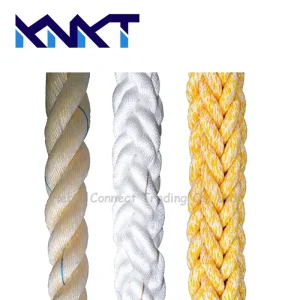
HMPE (high-modulus polyethylene), also called UHMWPE, is a high-performance synthetic fibre. Well-known branded versions such as Dyneema fall into this category. The fibre is used to manufacture high-strength ropes for demanding applications where low weight, low elongation and easy handling are important.
In marine and offshore service, HMPE ropes are valued because they:
- Weigh far less than steel for the same rated strength
- Resist corrosion and absorb almost no water
- Often float (specific gravity typically below 1.0), depending on construction and terminations
- Are easier and safer for crews to handle on deck
Performance still depends on fibre grade, braid or parallel construction, protective covers or coatings, splice quality and the exact operating conditions. Custom HMPE mooring ropes are frequently specified with abrasion-resistant jackets and specialised terminations for permanent or temporary mooring systems.
What Is Steel Wire Rope?
Steel wire rope is made from high-tensile steel wires twisted into strands around a core. Constructions vary widely (6×19, 6×36, rotation-resistant, etc.) to suit different needs for flexibility, fatigue life and resistance to rotation.
It has been the industry workhorse for decades on offshore cranes, winches, towing gear and many mooring systems. Engineers understand its behaviour thoroughly, and most existing equipment — drums, sheaves, sockets and fairleads — was designed around wire rope.
The main drawbacks are weight and corrosion.
Steel wire rope can require appropriate lubrication, corrosion protection and storage. Inspection must also consider broken wires, corrosion, crushing, kinking, birdcaging, diameter reduction and termination damage.
HMPE Rope vs Wire Rope: Direct Comparison

| Criterion | HMPE Rope | Steel Wire Rope |
| Weight | Extremely high strength-to-weight ratio | Considerably heavier, especially in large diameters |
| Buoyancy | Many HMPE rope constructions float, subject to covers and terminations | Sinks in water |
| Corrosion | Does not corrode like steel and has low water absorption. | Requires lubrication, corrosion protection and suitable storage. |
| Temperature Tolerance | Limited (Sensitive to heat and friction) | Higher temperature tolerance |
| Abrasion / cutting | Good with covers; vulnerable to sharp edges | Generally tougher against rough contact |
| Flexibility | Superior flexibility | Less flexible |
| Stretch/screep | Low elastic stretch; possible long term creep | Higher stretch |
| Cost | Often has a higher initial purchase price. | Often has a lower initial cost |
| Handling & Safety | Lighter, no shrp broken wires | Heavier; risk of “fishhooks” |
When HMPE Rope Is Usually the Better Choice
HMPE shines in applications where weight and handling matter most:
- Deepwater lifting and deployment – The self-weight of a long steel wire can consume a large portion of crane or winch capacity. A lighter HMPE line leaves more capacity for the payload.
- Mooring systems (including SPM and vessel-to-vessel) – Reduced weight and corrosion resistance improve safety and lower lifetime cost. Many operators now specify custom HMPE mooring ropes for this reason.
- Situations with restricted deck space or limited handling equipment.
- Operations where a floating line reduces the risk of fouling propellers or the seabed.
- Environments where corrosion and the need for constant greasing are major concerns.
Crews also appreciate the absence of sharp broken wires.
When Steel Wire Rope Remains Preferable
Wire rope is often still the practical choice when:
- The existing winch, crane, drum and sheaves were engineered specifically for steel wire.
- The line will contact rough or abrasive surfaces that could cut synthetic fibres.
- Higher operating temperatures or brake heat are expected.
- Client, class society or flag-state rules currently specify wire rope.
- Established inspection and discard criteria are required without additional training or procedure changes.
- A full equipment conversion (new sheaves, revised spooling, new terminations) would be too costly or time-consuming.
In short, if the entire system is already optimised for wire and the duty does not benefit strongly from weight reduction, staying with steel is frequently the lower-risk decision.
Can You Replace Wire Rope with HMPE on Existing Equipment?
Not always as a direct swap. Before converting a winch or crane:
- Confirm drum diameter, groove profile and fleet angle compatibility.
- Check coefficient of friction and multilayer spooling behaviour.
- Verify bend radius (D/d ratio) and heat generation at brakes.
- Ensure terminations and splices meet the required efficiency.
- Obtain manufacturer and class approval for the specific system.
A successful conversion usually involves adjusted operating procedures and new inspection criteria rather than simply changing the rope.
Practical Selection Checklist for Marine & Offshore Projects
- Define the exact duty: mooring, lifting, towing, deployment or recovery.
- Calculate static + dynamic loads, including shock factors and load duration.
- Review equipment limitations (winch, sheaves, fairleads).
- Assess environmental factors: seawater, UV, heat, abrasion risk.
- Compare certified breaking strength and elongation data of finished assemblies.
- Factor in total cost of ownership – transport, handling, maintenance and downtime.
- Confirm inspection methods and retirement criteria are practical for your crew.
- Verify required certifications and class approvals.
Making the Right Choice for Your Operation
There is no single winner between HMPE rope and wire rope. HMPE offers clear advantages in weight, corrosion resistance and handling for many marine and offshore tasks, while steel wire remains strong where abrasion resistance, temperature tolerance and existing equipment compatibility matter most.
The right decision comes from matching the complete rope assembly — construction, terminations and protection — to your specific application.
Need help selecting the optimal solution for your mooring, lifting or towing project? Contact our team for technical advice and custom HMPE rope options tailored to your requirements.